- 0 ft
- 500 ft
- 1,000 ft
- 1,500 ft
- 2,000 ft +
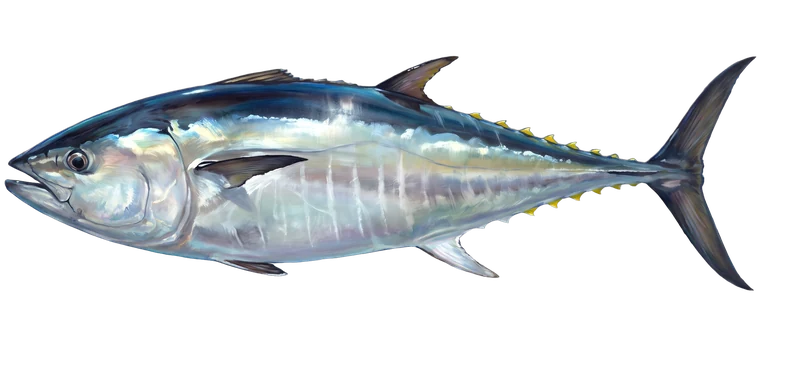
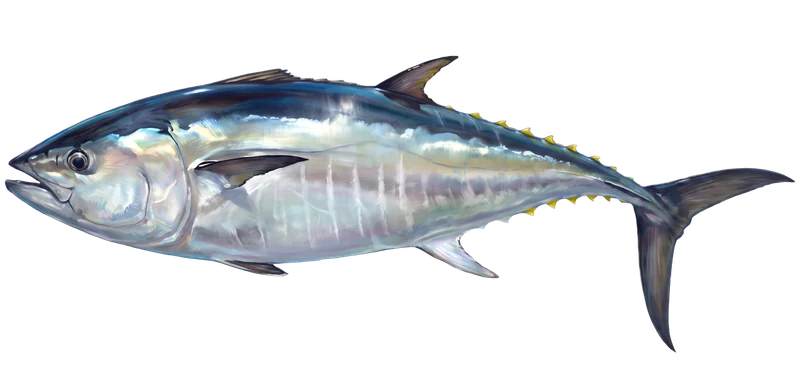
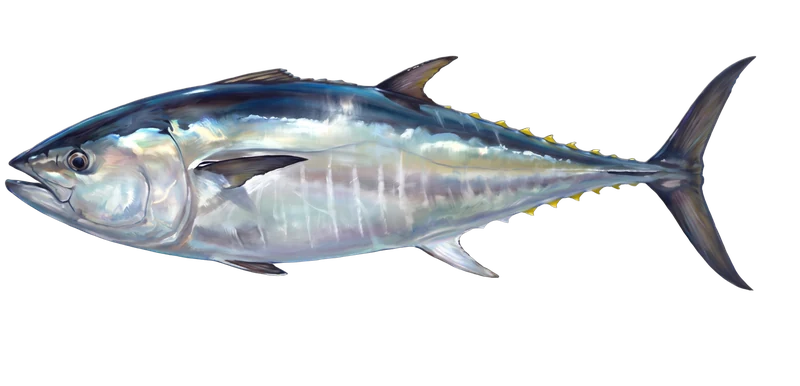
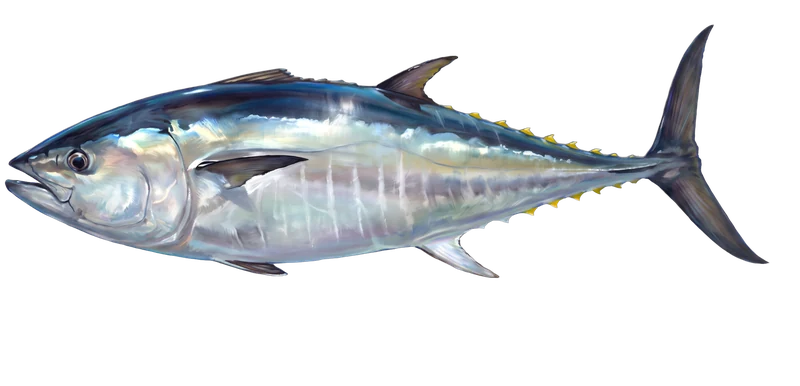
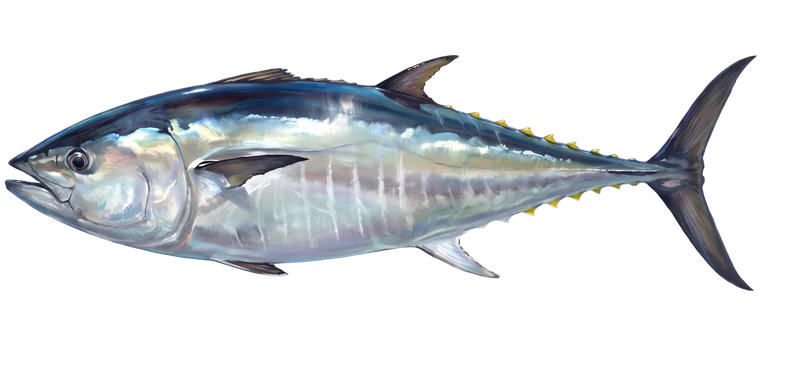
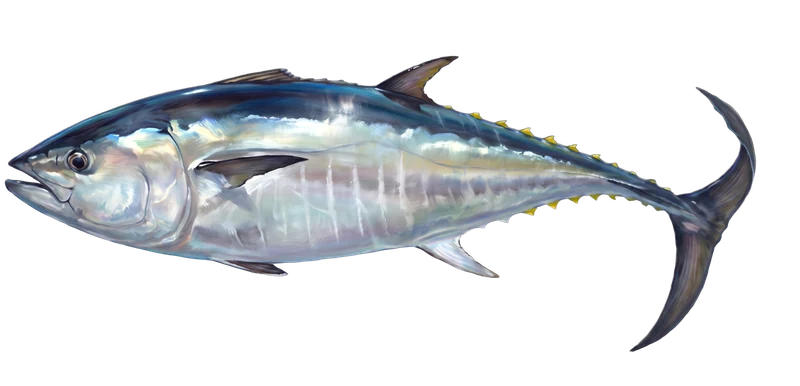
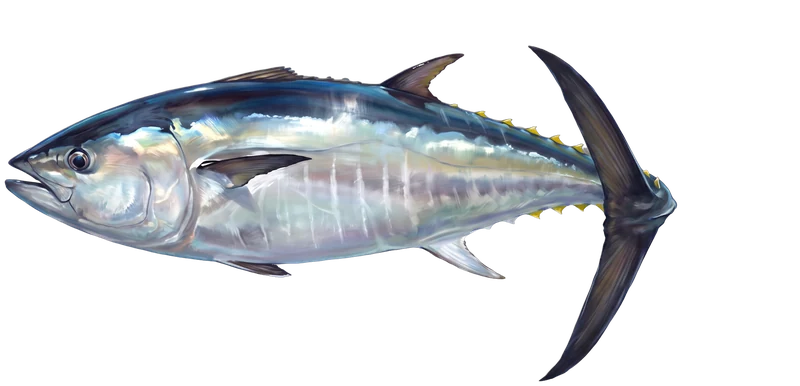
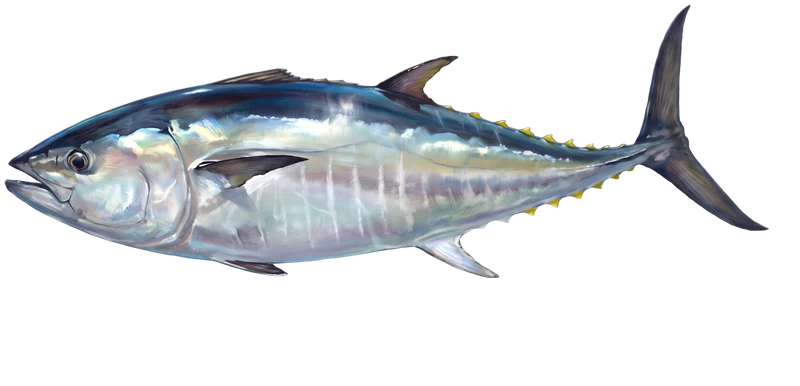
Bluewater
Bluefin Tuna
Thunnus thynnus
Depth0–2,000 ft +
Giant bluefin migrate north past Bimini in late spring on their return from Gulf of Mexico spawning grounds.
- Largest recorded1,506 lb15 ft
- Depth range0–3,000 ftspecies-wide
- IGFA all-tackle1,496 lbAulds Cove, Nova Scotia, Canada · 1979
How big, really
A bluefin tuna and a six-foot adult, drawn to one scale.

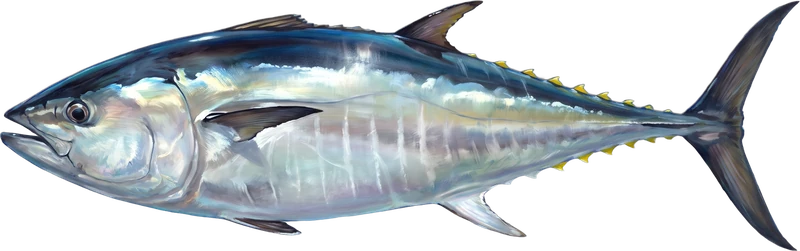
Bluefin Tuna · Largest recorded · 15 ft (180 in)vsAdult · 6 ft
The bluefin tuna year
Twelve months around the dial, straight from the island's season data — peak months reach the outer ring. Pick a month to see what else is running. Peak: May.
PeakMay
January — Bluefin Tuna is off season
Also running this month
- BonefishPeak
- WahooPeak
- PermitGood
- Yellowtail SnapperGood
February — Bluefin Tuna is off season
Also running this month
- BonefishPeak
- WahooPeak
- PermitGood
- Yellowtail SnapperGood
March — Bluefin Tuna is off season
Also running this month
- BonefishPeak
- PermitPeak
- Blue MarlinGood
- Mahi (Dolphin)Good
- SailfishGood
- WahooGood
- Yellowtail SnapperGood
April — Bluefin Tuna is off season
Also running this month
- Blue MarlinPeak
- BonefishPeak
- Mahi (Dolphin)Peak
- PermitPeak
- SailfishPeak
- Yellowtail SnapperGood
May — Bluefin Tuna is peak
Also running this month
- Blue MarlinPeak
- BonefishPeak
- Mahi (Dolphin)Peak
- PermitPeak
- SailfishPeak
- TarponGood
- Yellowtail SnapperGood
June — Bluefin Tuna is good
Also running this month
- Blue MarlinPeak
- BonefishPeak
- GrouperPeak
- Mahi (Dolphin)Peak
- PermitPeak
- TarponPeak
- Yellowtail SnapperPeak
- SailfishGood
July — Bluefin Tuna is off season
Also running this month
- Blue MarlinPeak
- BonefishPeak
- GrouperPeak
- PermitPeak
- TarponPeak
- Yellowtail SnapperPeak
- Mahi (Dolphin)Good
August — Bluefin Tuna is off season
Also running this month
- BonefishPeak
- GrouperPeak
- PermitPeak
- TarponPeak
- Yellowtail SnapperPeak
September — Bluefin Tuna is off season
Also running this month
- BonefishPeak
- PermitGood
- TarponGood
- Yellowtail SnapperGood
October — Bluefin Tuna is off season
Also running this month
- BonefishPeak
- PermitGood
- Yellowtail SnapperGood
November — Bluefin Tuna is off season
Also running this month
- BonefishPeak
- WahooPeak
- PermitGood
- Yellowtail SnapperGood
December — Bluefin Tuna is off season
Also running this month
- BonefishPeak
- WahooPeak
- PermitGood
- Yellowtail SnapperGood
Field notes
- How it is fished
- Historically trolling rigged bait/daisy chains (the method used for the IGFA record fish); modern giant-bluefin fishing also uses chunking and live-baiting.
- What it eats
- Small schooling fish, especially anchovies, pursued energetically; smaller prey can be taken via modified filter-feeding; nearshore fish also take starfish, kelp, and shallow-water fishes.
- Depth
- Florida Museum: observed both above and below the thermocline, to depths greater than 3,000 ft; highly migratory with a wide temperature tolerance.
- Worth knowing
- Atlantic bluefin tuna are regionally endothermic ('warm-blooded') — a rete mirabile (countercurrent heat-exchange vascular network) keeps their swimming muscles, eyes, brain, and viscera up to 10-15°C (in some cases up to 21°C) warmer than the surrounding water, letting them hunt effectively from tropical spawning grounds to sub-polar waters. Tagged adults have completed transatlantic crossings in under 60 days at speeds up to 45 mph.
- Conservation & rules
- This status is genuinely nuanced and easy to get wrong. IUCN Red List: Least Concern (downgraded from Endangered in the 2021 update) — but this masks divergent trends: the larger Eastern Atlantic/Mediterranean stock has increased more than 22% over the last four decades, while the smaller native Western Atlantic stock (the one that migrates past Bimini) has declined by more than half over the same period. NOAA's assessment lists the Western Atlantic stock as not currently subject to overfishing, but its overfished status is unknown. ICCAT sets binding catch quotas (TACs); the 2023-2025 TAC was 2,726 mt for the Western Atlantic and 40,570 mt for the Eastern Atlantic/Mediterranean; at the November 2025 ICCAT meeting, 2026-2028 quotas were increased to 3,081.6 mt (Western, +13%) and 48,403 mt (Eastern/Mediterranean, +19.3%). The U.S. baseline domestic quota is 1,316.14 mt.
The record
1,496 lbIGFA all-tackle world record
Angler Ken Fraser · Aulds Cove, Nova Scotia, Canada · 1979
Where it lives
The island's relief model with bluewater lit — 2,000 ft +, the Gulf Stream edge, a mile off the beach. Drag it to change the angle.








The Bimini story
Giant bluefin migrate north past Bimini in late spring on their return from Gulf of Mexico spawning grounds, per longstanding local reputation. Ernest Hemingway fished for giant bluefin out of Bimini in 1935; the best-documented claim is that on May 21, 1935 he landed the first unmutilated giant tuna taken there on rod and reel, ending roughly three years in which sharks had 'apple-cored' every giant tuna hooked in Bahamian waters before it could be boated, with a second tuna the following day reported at 381 lb. The commonly repeated claim of two Hemingway tuna weighing 514 lb and 610 lb could NOT be traced to any primary source, cited biography, or IGFA historical material — it appears only in uncited blog content repeated verbatim across sites, and should be treated as unverified folklore rather than fact. Separately, a widely repeated '786 lb' Hemingway-at-Bimini figure is a documented case of source conflation: that fish was actually a mako shark, not a tuna. A well-documented but distinct episode — a Hemingway letter dated May 8, 1935, later authenticated and auctioned — describes a blue marlin (not tuna) caught by his friend Henry Strater on May 7, 1935 off North Bimini that would have weighed an estimated 700-900 lb intact but was reduced to 500 lb at the dock after sharks tore into it while it was being fought. The Bimini Big Game Club, founded 1936, capitalized on the fame Hemingway's 1935 season brought to Bimini's big-game fishery. For citable exact tuna weights beyond what is listed here, the strongest available secondary source identified but not accessed in full is Ashley Oliphant's 'Hemingway and Bimini: The Birth of Sport Fishing at The End of the World' (Pineapple Press, 2017), researched on an Ernest Hemingway Research Grant at the JFK Presidential Library.
Sources
- floridamuseum.ufl.edu
- massbayguides.com
- iucn.org
- fisheries.noaa.gov
- onthewater.com
- noaa.gov
- anglersjournal.com
- foxnews.com
- masgc.org
- biggameclubbimini.com
What we could not verify (3)
- Typical angler-catch length/weight range.
- The '514 lb and 610 lb' Hemingway Bimini tuna figures — could not be traced to any primary source; treat as unverified popular claim, not fact.
- IGFA record could not be re-confirmed directly on igfa.org's live database; relied on consistent secondary reporting.